
Arts
Origins of the Camorra: History, Legends, and the Development of Criminal Power
A journey through myth

Camorristi (Source: Antonio Nacarlo)
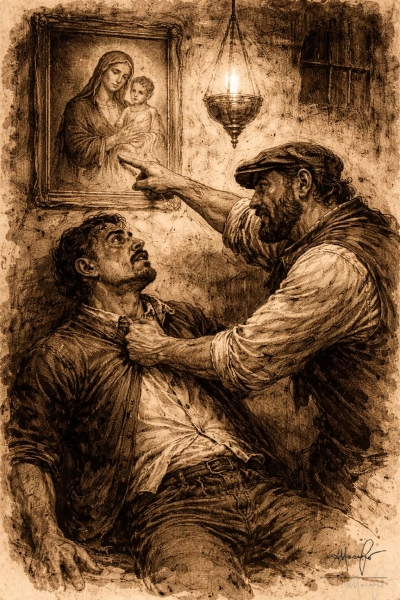
olio della Madonna
(Source: Antonio Nacarlo)
(Source: Antonio Nacarlo)
What is the Camorra, and why was its name not spoken?
The word “Camorra” has a controversial history. In the past, both those who fought against this phenomenon and those who were part of it avoided using the term. Legislators feared that doing so would legitimize a criminal organization, while its members preferred to describe themselves as “nobles of the plebs”, dispensers of justice in the gaps left by the State.
The uncertain etymology of the term “Camorra”
According to Isaia Sales, “Camorra” was initially synonymous with extortion. There are several etymological hypotheses:
From the Arabic term kumar, referring to a brawl or gambling (also mentioned in the Quran).
From the “company of gamurra”, a Cagliari-based mercenary militia of the 13th century.
From the guarduna, a Spanish criminal brotherhood mentioned by Cervantes.
From the game of morra, as attested by a Bourbon decree of 1735.
The word “Camorra” has a controversial history. In the past, both those who fought against this phenomenon and those who were part of it avoided using the term. Legislators feared that doing so would legitimize a criminal organization, while its members preferred to describe themselves as “nobles of the plebs”, dispensers of justice in the gaps left by the State.
The uncertain etymology of the term “Camorra”
According to Isaia Sales, “Camorra” was initially synonymous with extortion. There are several etymological hypotheses:
From the Arabic term kumar, referring to a brawl or gambling (also mentioned in the Quran).
From the “company of gamurra”, a Cagliari-based mercenary militia of the 13th century.
From the guarduna, a Spanish criminal brotherhood mentioned by Cervantes.
From the game of morra, as attested by a Bourbon decree of 1735.
Origins of the Camorra: Osso, Mastrosso and Carcagnosso
A popular legend tells of three knights, three Galician brothers — Osso, Mastrosso and Carcagnosso — who were sentenced for killing a local nobleman who had violated their sister’s honor. They founded, in the harsh prison of the island of Favignana, the three criminal organizations: the Camorra, the Mafia and the ’Ndrangheta. They also wrote their code of rules, known as the “Frjeno”. Although this is a myth, it is historically established that the Camorra emerged in Bourbon prisons during the 19th century.
A popular legend tells of three knights, three Galician brothers — Osso, Mastrosso and Carcagnosso — who were sentenced for killing a local nobleman who had violated their sister’s honor. They founded, in the harsh prison of the island of Favignana, the three criminal organizations: the Camorra, the Mafia and the ’Ndrangheta. They also wrote their code of rules, known as the “Frjeno”. Although this is a myth, it is historically established that the Camorra emerged in Bourbon prisons during the 19th century.
more information: https://https://www.napoliupclose.it/
Liability for this article lies with the author, who also holds the copyright. Editorial content from USPA may be quoted on other websites as long as the quote comprises no more than 5% of the entire text, is marked as such and the source is named (via hyperlink).